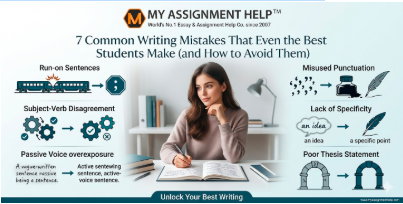
7 Common Writing Mistakes That Even the Best Students Make (and How to Avoid Them)
Academic excellence is often measured by the clarity of one’s arguments and the precision of their prose. Even high-achieving students—those who spend weeks in the library and possess a deep understanding of their subject matter—frequently stumble over subtle writing traps. These errors do more than just lower a grade; they obscure brilliant ideas and weaken the writer’s authority.
To maintain high E-E-A-T (Experience, Expertise, Authoritativeness, and Trustworthiness) standards, academic writing must be rigorous. However, the pressure to sound “academic” often leads to over-complication. Many students believe that complex sentences equate to intelligence, but in reality, clarity is the ultimate sophistication. Before submitting your next major essay, it is wise to rate my paper to identify hidden patterns of error that manual proofreading might miss.
Understanding these common pitfalls is the first step toward transforming a “good” essay into an “exceptional” one. Here are the seven most common writing mistakes made by top-tier students and the data-driven strategies to avoid them.
1. The “Academic Verbosity” Trap
High-achieving students often suffer from “thesaurus syndrome.” They replace simple, effective words with multisyllabic alternatives to sound more scholarly.
- The Mistake: Using “utilize” instead of “use,” or “in spite of the fact that” instead of “although.”
- The Fix: Aim for a “lean” prose style. Research from the Journal of Applied Cognitive Psychology suggests that unnecessarily complex language actually lowers the reader’s perception of the author’s intelligence. Focus on active verbs and direct statements.
2. Over-Reliance on Passive Voice
While the passive voice has its place in scientific methodology, overusing it makes your writing feel detached and sluggish.
- The Mistake: “The experiment was performed by the team” (Passive) vs. “The team performed the experiment” (Active).
- The Fix: Use the active voice to take ownership of your arguments. It reduces word count and increases the “punch” of your conclusions.
3. Weak Transition Logic
Top students often have complex thoughts, but they sometimes fail to build a bridge for the reader to follow them.
- The Mistake: Jumping from one paragraph to the next without explaining the logical connection.
- The Fix: Use “signposting.” Phrases like “In contrast to,” “Building upon this evidence,” or “Consequently” act as a roadmap for your professor.
4. Quote Dumping (Lack of Synthesis)
Including a quote isn’t enough; you must explain why it matters.
- The Mistake: Ending a paragraph with a quote and moving on.
- The Fix: Follow the “Quote Sandwich” method: Introduce the quote, provide the quote, and then spend at least two sentences analyzing it in your own words.
5. Vague Pronoun References
Precision is the hallmark of academic writing. Vague pronouns like “this,” “that,” or “it” can confuse the reader if the antecedent isn’t clear.
- The Mistake: “The government implemented a new policy. This was controversial.” (What was controversial? The implementation? The policy? The timing?)
- The Fix: Be specific. “This policy sparked controversy because…”
6. Misaligned Tone and Register
Writing for a Law professor requires a different “voice” than writing for a Creative Arts instructor.
- The Mistake: Using colloquialisms, contractions (don’t, can’t), or overly emotional language in a formal report.
- The Fix: Mirror the language found in your course’s peer-reviewed readings. If you find the transition between subjects difficult, professional assignment writing services can provide model papers that demonstrate the correct tone for various disciplines.
7. The “Final Minute” Proofreading Error
Even the best arguments are undermined by a “their/there” mix-up or a missing comma.
- The Mistake: Relying solely on basic spell-checkers.
- The Fix: Read your paper aloud. Your ears will often catch rhythmic errors and awkward phrasing that your eyes gloss over.
Key Takeaways
- Prioritize Clarity: Sophistication comes from clear logic, not complex vocabulary.
- Active Over Passive: Keep the reader engaged by using active verbs.
- Synthesis is King: Never let a source speak for you; always explain its relevance to your thesis.
- Signpost Your Path: Use transitions to guide the reader through your logical steps.
- Tone Matters: Ensure your writing style matches the academic discipline.
Data and Sources
According to a 2023 study on student writing trends, approximately 60% of undergraduate grade deductions in the US are attributed to structural clarity and citation errors rather than a lack of subject knowledge. Furthermore, the National Assessment of Educational Progress (NAEP) indicates that students who utilize iterative drafting processes score 15% higher on average than those who submit first drafts.
References:
- Oppenheimer, D. M. (2006). Consequences of erudite vernacular utilized irrespective of necessity: Problems with using long words needlessly. Journal of Applied Cognitive Psychology.
- Strunk, W., & White, E. B. (2000). The Elements of Style. Longman.
- Zinsser, W. (2006). On Writing Well. Harper Perennial.
FAQ Section
Q: Is passive voice always wrong in academic writing?
A: No. It is often preferred in the “Methods” section of lab reports. However, for argumentative essays in Humanities and Social Sciences, the active voice is generally stronger.
Q: How can I tell if my tone is too informal?
A: Look for contractions (like “won’t”), first-person pronouns (unless permitted), and “filler” words like “basically” or “actually.” If your essay sounds like a conversation, it’s likely too informal.
Q: Why is “quote dumping” considered a mistake?
A: Professors want to grade your understanding, not your ability to copy-paste. A quote without analysis suggests you don’t fully grasp how the evidence supports your point.
About the Author: Sarah Jenkins
Sarah Jenkins is a Senior Academic Consultant at MyAssignmentHelp with over 10 years of experience in higher education publishing. Holding a Master’s degree in English Literature, Sarah specializes in helping students navigate the complexities of E-E-A-T standards in digital and traditional academic content. She has mentored thousands of students across the US and UK in perfecting their argumentative prose and maintaining academic integrity.